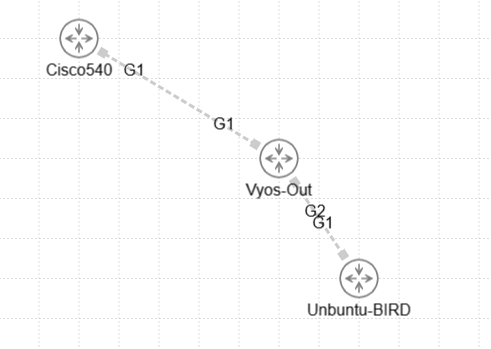
You can see the links above i mocked it up quickly in CML
VyOS-Out:~$ show interfaces

Codes: S - State, L - Link, u - Up, D - Down, A - Admin Down
Interface    IP Address         MAC  VRF      MTU  S/L  Description
-----------  -----------------  ---  -------  ---  ---  -----------
eth3         X.X.X.54/30         n/a  default  n/a  u/u  WAN
             X:X:a120:7::3/64
eth4         172.26.0.102/30     n/a  default  n/a  u/u  LAN
eth5         X.X.X.85/30         n/a  default  n/a  u/u  DMZ
             X:x:a120:9::2/64
lo           127.0.0.1/8         n/a  default  n/a  u/u
             ::1/128
Real config up top shows the WAN interface going to the 540 and the DMZ going toward the Ubuntu-BIRD host
Now i have zone-policy zones setup for each DMZ and WAN and i have address-group and ipv6-address-group setup for the endpoints behind UBUNTU
I have firewall ipv6-name rules
set firewall ipv6-name to-DMZ-from-LOCAL6 default-action 'accept'
set firewall ipv6-name to-DMZ-from-WANv6-1 default-action 'accept'
set firewall ipv6-name to-DMZ-from-WANv6-1 rule 80 action 'accept'
set firewall ipv6-name to-DMZ-from-WANv6-1 rule 80 description 'DNS from ANY to AnyCastv6 Group'
set firewall ipv6-name to-DMZ-from-WANv6-1 rule 80 destination group address-group 'AnyCastv6'
set firewall ipv6-name to-DMZ-from-WANv6-1 rule 80 destination port '53'
set firewall ipv6-name to-DMZ-from-WANv6-1 rule 80 protocol 'udp'
to allow DNZ queries to my Ubuntu-BIrd server
set zone-policy zone DMZ from WAN firewall ipv6-name 'to-DMZ-from-WANv6-1'
Now lets talk about routing
vyos@Vyos-Out:\~$ show ipv6 route bgp
Codes: K - kernel route, C - connected, S - static, R - RIPng,
O - OSPFv3, I - IS-IS, B - BGP, N - NHRP, T - Table,
v - VNC, V - VNC-Direct, A - Babel, D - SHARP, F - PBR,
f - OpenFabric,
> - selected route, \* - FIB route, q - queued route, r - rejected route

B>\* ::/0 \[20/0\] via fe80::b64c:90ff:fe30:ef85, eth3, 00:59:50
B>\* X:X:a100:1::7/128 \[20/0\] via fe80::250:56ff:feae:a823, eth5, 00:59:55
B>\* X:X:a101:1::7/128 \[20/0\] via fe80::250:56ff:feae:a823, eth5, 00:59:55
You can see Ubuntu i sending the anycast bind ip’s
vyos@Vyos-Out:\~$ show ipv6 route connected
Codes: K - kernel route, C - connected, S - static, R - RIPng,
O - OSPFv3, I - IS-IS, B - BGP, N - NHRP, T - Table,
v - VNC, V - VNC-Direct, A - Babel, D - SHARP, F - PBR,
f - OpenFabric,
> - selected route, \* - FIB route, q - queued route, r - rejected route

C>\* X:X:a120:7::/64 is directly connected, eth3, 01:02:04
C>\* X:X:a120:9::/64 is directly connected, eth5, 01:02:04
C \* fe80::/64 is directly connected, eth3, 01:02:04
C \* fe80::/64 is directly connected, eth4, 01:02:04
C \* fe80::/64 is directly connected, eth4, 01:02:04
C \* fe80::/64 is directly connected, eth5, 01:02:05
C>\* fe80::/64 is directly connected, lo, 01:02:06
While connected routes are shared into vyos’ routing table
Anything else you might need to know?
Thanks for responding.